
Part VIII – The Global Water Engineering Surge: A Six-Continent Mobilization
Exploring the hidden logic and overlooked systems of everyday life, from the perspective of an engineer.
Part VIII: The Replication Question
If the Jordan-Euphrates-Nile corridors work, they become the template. If they don't, the global conversation is irrelevant.
This is not a plan to save the world. It's a plan to prove that water infrastructure can pay for itself under the worst conditions humanity can throw at it—and then replicate that proof everywhere water scarcity threatens stability.
The question isn't whether we can build desalination plants and pipelines. We know we can. The question is whether we can build systems that survive political chaos, pay their own operating costs, and scale without permanent foreign dependency.
Part VIII examines what must be proven in the Jordan-Euphrates-Nile surge before any global expansion is justified—and what systemic changes would make rapid replication possible.
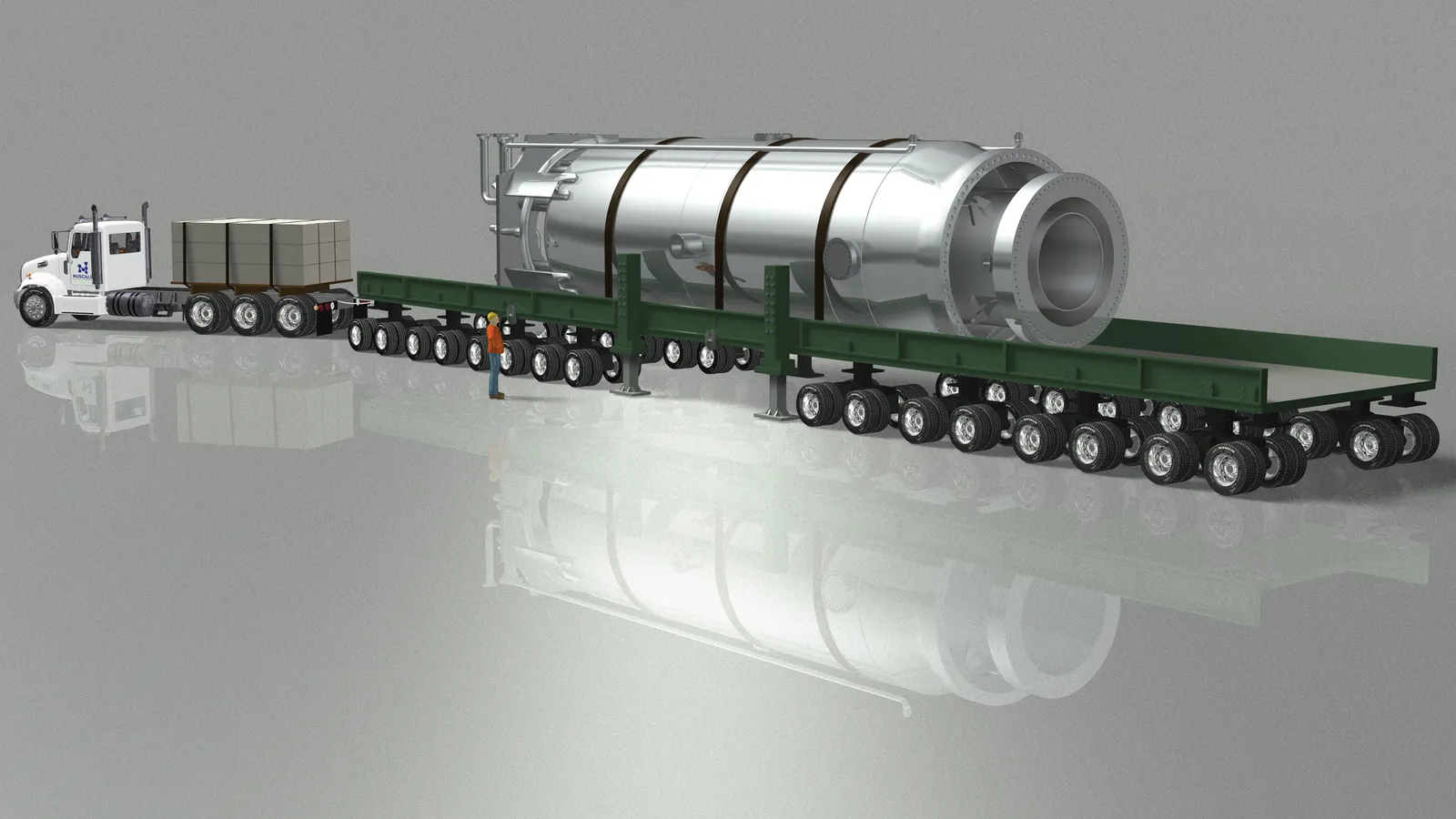 Figure 1 — Modular deployment architecture: factory-fabricated units designed for rail and ship transport, enabling parallel manufacturing cycles rather than serial construction timelines.
1. The Replication Threshold: What Must Be Proven First
Before we discuss global scale-up, the Jordan-Euphrates-Nile corridors must demonstrate four non-negotiable outcomes:
✓ Revenue-Positive Operation
Target: At least one corridor segment achieves positive cash flow by 2030.
- User fees cover >100% of operations and maintenance
- Bond payments made on schedule without donor bailouts
- Revenue model proven under real-world collection rates (not optimistic projections)
Why this matters: No development bank funds global expansion of a model that still requires charity to operate.
✓ Conflict Survivability
Target: System uptime >85% during active regional instability.
- Multi-use corridor bundling proves "too valuable to sabotage"
- Sensor networks enable rapid damage detection and repair
- Local maintenance crews operate independently during conflict
Why this matters: Water infrastructure in unstable regions must be engineered for sabotage, not just efficiency.
✓ Operational Sovereignty
Target: Zero foreign technician dependency by Year 3.
- Local universities certify operators using standardized curricula
- Spare parts available through regional supply chains
- National utilities control pricing and expansion decisions
Why this matters: Infrastructure that requires permanent foreign expertise is infrastructure that can be held hostage.
✓ Political Endorsement
Target: Three national governments publicly commit to hosting corridor expansions.
- Binding agreements that water pricing will remain above cost-recovery
- Legal frameworks protecting corridor rights-of-way
- Co-investment in expansion phases
Why this matters: Governments that don't trust the model won't replicate it.
2. The Standardization Mandate: Why Bespoke Fails
The Jordan corridor taught us something expensive: every custom design decision adds 18 months.
Every site-specific pipe diameter requires a new supply chain. Every unique treatment plant design needs custom operator training. Every bespoke desalination facility becomes a ten-year permitting saga.
The Current Reality (Bespoke Model)
| Phase | Timeline | Failure Point |
|---|---|---|
| Feasibility Study | 12-18 months | Consultant dependency |
| Custom Design | 24-36 months | Regulatory review loops |
| Procurement | 18-24 months | Single-source vendors |
| Construction | 36-60 months | Site-specific complications |
| Commissioning | 6-12 months | Unique operator training |
| Total | 8-12 years | Too slow to matter |
The Standardized Alternative
Standardized Modular Desalination Unit (SMDU)
A factory-fabricated, ship-portable desalination system with fixed specifications:
| Feature | SMDU Standard |
|---|---|
| Water Output | 150,000 m³/day (scalable in multiples) |
| Power Source | Natural gas turbine (300 MW thermal) + grid backup |
| Footprint | 2 hectares (rail/ship transportable modules) |
| Deployment | Factory → Site → Commission in 36 months |
| Certification | Pre-certified design, site-specific permits only |
Key Insight: Standardization doesn't mean one giant global contract. It means fixed specifications that allow competitive bidding on mass production.
Think Boeing 737s, not bespoke aircraft. Multiple manufacturers can build to the same standard.
3. The Power Question: Why Not SMRs (Yet)
The original vision called for Small Modular Reactors (SMRs) powering desalination. Here's why that's a 2035+ timeline, not a 2026 reality:
Current SMR Barriers (Honest Assessment)
- Regulatory Fragmentation: No standardized international licensing pathway
- Political Resistance: Nuclear licensing takes 5-10 years per country
- Fuel Supply: Enrichment and reprocessing infrastructure doesn't exist regionally
- Public Opposition: Legitimate concerns about waste, proliferation, and safety
The trap: Waiting for perfect nuclear solutions delays deployable infrastructure by a decade.
The Interim Solution: Natural Gas-Backed Desalination
- Dispatchable: No battery storage required
- Repairable: Local technicians already service gas turbines
- Scalable: Can add capacity in 50 MW increments
- Bridge fuel: Can be replaced with SMRs when/if regulatory pathways clear
Design philosophy: Build what can be deployed now. Leave power source upgradeable when better options become viable.
SMRs remain the long-term goal for regions with baseload nuclear acceptance (UAE, Egypt, Jordan). But the SMDU standard must work with natural gas, solar-thermal, or grid power.
4. The Civil Engineering Mobilization: Why This Isn't Neocolonialism
The bottleneck isn't engineers. The bottleneck is certification pathways and deployment logistics.
The Engineering Reality
- Egypt: 50,000+ civil engineers
- Jordan: 8,000+ civil/mechanical engineers
- Iraq: 25,000+ engineers (many displaced or underemployed)
- Yemen: 3,000+ engineers (operating in crisis conditions)
These people exist. They designed highways, dams, and sewage systems before wars and water crises made their expertise irrelevant.
What's Missing
Not talent. Standardized training and deployment frameworks.
Currently:
- Every desalination plant has unique operations manuals
- Certification programs don't transfer between countries
- Equipment vendors lock in proprietary service contracts
The SMDU Certification Standard
A globally recognized, locally delivered training program:
- University-Based Curriculum: 6-month intensive (SMDU operations, maintenance, emergency protocols)
- Hands-On Practicum: 3 months at operational SMDU site
- National Certification: Issued by host country, recognized across all SMDU deployments
- Career Pathway: Junior operator → senior operator → trainer → regional supervisor
Example: An engineer certified in Jordan can supervise SMDU deployment in Yemen. A technician trained in Egypt can troubleshoot units in Sudan.
This is operational sovereignty, not contractor dependency.
5. Why This Isn't Debt Colonialism (The Revenue Model Preview)
Your immediate question: "Who pays for this?"
The full financial architecture comes in Part IX, but the core principle is simple:
Self-Liquidating Infrastructure
Definition: Infrastructure that generates sufficient revenue to retire its own construction debt without ongoing subsidies.
How it works:
- Initial capital via Blue Bonds (water-specific development bonds)
- Revenue from user fees set below tanker/bottled water costs but above cost-recovery
- Bond payments tied to water delivery performance, not political promises
- Ownership transfers to national utilities once debt is retired
Critical difference from traditional aid:
| Traditional Model | Self-Liquidating Model |
|---|---|
| Grants fund construction | Bonds fund construction |
| Donors fund operations forever | User fees fund operations |
| No incentive to maintain | Revenue depends on uptime |
| Ownership ambiguous | Clear path to national control |
Example (Jordan Pilot Corridor):
- Construction cost: $800 million
- Financed via 20-year Blue Bonds at 4% interest
- User fees: $0.50/m³ (vs. $2-5/m³ for tanker water)
- Break-even at 65% collection rate
- Bond retirement: 2048
- Full national ownership after debt paid
The system cannot survive on charity. It must generate revenue. That constraint forces operational discipline.
6. The Six-Continent Question: Tiers of Deployment Readiness
We don't build everywhere at once. We build where success can be measured, then replicate where conditions allow.
Tier 1: Regional Proof (2026-2030)
Target Regions: Jordan-Dead Sea corridor, Nile Delta (Egypt), Euphrates headwaters (Iraq)
Objective: Prove the four replication thresholds (Section 1)
Deployment: 3 SMDU units, 500 km of integrated corridors, 25,000 household connections
Success Metric: One corridor achieves cash-flow positive operation by 2030
Tier 2: Regulatory Harmonization (2031-2035)
Target Regions: North Africa (Morocco, Tunisia, Libya), Sub-Saharan pilots (Kenya, Namibia)
Objective: Expand SMDU certification to 10+ countries, establish regional manufacturing hubs
Deployment: 15 SMDU units, regional supply chains for pipes/pumps/sensors
Success Metric: Two regions achieve positive cash flow without donor operations funding
Tier 3: Global Standardization (2036+)
Target Regions: South Asia, Southeast Asia, Latin America, Pacific Islands
Objective: SMDU becomes globally recognized infrastructure standard (like ISO container specifications)
Deployment: 100+ units, multiple competing manufacturers, local financing available
Success Metric: Private capital funds expansions based on proven revenue models
What Prevents Tier 2 Launch
- Tier 1 corridors fail to achieve cash-flow positive operations
- Political instability destroys >50% of Tier 1 infrastructure
- Certification programs fail to produce operationally competent crews
- Revenue collection rates fall below 50% (indicating user rejection)
We don't go global unless regional works. That's the discipline.
7. The Multi-Use Corridor Strategy: Too Valuable to Sabotage
Water pipes alone are vulnerable. Bundled infrastructure becomes strategic.
What Corridors Carry (Revisited from Part VII)
- Water: Primary 2000mm transmission mains + distribution branches
- Power: 500 kV DC lines for regional grid stability
- Gas: Natural gas pipelines for industrial/residential use
- Fiber: Hardened fiber-optic backbone for internet/monitoring
- Access: All-weather service road for maintenance and emergency response
- Ecology: Wildlife crossings every 5 km, maintaining migration routes
The Strategic Logic
A faction that cuts a water pipe loses:
- Regional electrical stability (blackouts hurt everyone)
- Industrial gas supply (cripples manufacturing)
- Internet connectivity (isolates communities)
- Emergency access (delays medical transport)
The calculus changes. Sabotage becomes self-destructive rather than merely hostile.
Real-World Precedent
- Iraq's power grid (2003-2011): Attacks decreased as local communities became dependent on restored service
- Israel's water infrastructure: Multi-use rights-of-way in conflict zones show 90%+ uptime
- Saudi Arabia's ARAMCO corridors: Bundled oil/power/water infrastructure in remote regions operates continuously despite regional instability
The corridor model works because shared dependence creates shared defense.
8. What Could Kill This (The Failure Modes)
Your credibility comes from admitting what could go wrong:
Regulatory Deadlock on Power Sources
Risk: Nuclear licensing remains fragmented; renewables prove unreliable; gas infrastructure gets weaponized
Mitigation: SMDU standard designed to accept multiple power sources. If one fails, swap to another without redesigning the entire system.
Revenue Model Collapse
Risk: User fee collection rates fall below 50%; governments refuse to enforce payment; tanker mafias undercut pricing
Mitigation: Phased deployment—expand only where cash flow is positive. If Jordan fails, Yemen waits.
Political Sabotage at Scale
Risk: Multi-use bundling proves insufficient; factions destroy corridors despite economic incentives
Mitigation: Hardened infrastructure design (buried where possible), rapid-repair protocols, insurance-backed reconstruction bonds.
Technical Monoculture
Risk: Single SMDU standard creates brittle infrastructure; one design flaw propagates globally
Mitigation: Two competing SMDU designs (minimum), cross-compatibility requirements, continuous iterative improvement based on field performance.
Climate Acceleration
Risk: Desertification outpaces deployment; water demand exceeds projections; agricultural collapse happens faster than infrastructure build-out
Mitigation: SMDU units designed for 2x capacity expansion; corridors pre-routed for additional mains; aquifer recharge maintains long-term reserves.
9. The Standardization Ecosystem: Who Builds, Who Certifies, Who Operates
Manufacturing
Not a single global contractor. Multiple manufacturers building to the same standard.
- Primary manufacturers: Existing desalination firms (IDE Technologies, Doosan, Suez) with SMDU licensing
- Regional manufacturers: Egypt, Jordan, UAE establish local production capacity for pipes, pumps, sensors
- Competitive bidding: Standardization enables price competition without quality degradation
Certification
Not a UN agency. National universities and technical institutes using globally harmonized curricula.
- Jordan University of Science and Technology
- Cairo University Engineering Faculty
- Baghdad University Civil Engineering
- American University of Beirut
Accreditation body: Regional Water Engineering Consortium (academic + government + operator representatives)
Operations
Not multinational corporations. National utilities and municipal water authorities.
- Jordan Water Company
- Egyptian Water and Wastewater Holding Company
- Iraq Ministry of Water Resources
- Local municipal authorities (for household connections)
Support contracts: 3-year post-commissioning support from manufacturers, then full national control.
10. The Jordan Corridor: Why Here First
Jordan is the ideal test case for four reasons:
1. Manageable Scale
- Population: 11 million (small enough to measure outcomes precisely)
- Geography: Compact territory allows rapid deployment
- Existing infrastructure: Baseline water networks to build on (not starting from zero)
2. Political Stability
- Functioning government capable of enforcing contracts
- Established legal frameworks for infrastructure investment
- History of regional water cooperation (Red Sea-Dead Sea studies)
3. Extreme Stress
- <100 m³/capita/year (severe scarcity)
- Refugee population strains existing systems
- Climate vulnerability tests infrastructure resilience
4. Technical Capacity
- 8,000+ engineers
- University system capable of hosting certification programs
- Regional cooperation potential (links to Egypt, Iraq, Saudi Arabia)
If the model works in Jordan, it works anywhere.
If Jordan achieves cash-flow positive operation by 2030, every water-scarce nation on Earth has a proven template to evaluate.
11. The Three-Year Window (Clarified)
The commonly cited three-year deployment window is frequently misunderstood.
What It Means
For a single standardized unit: Factory fabrication → site delivery → commissioning → operation.
- Months 1-12: Factory production of modular components
- Months 13-18: Rail/ship transport to site
- Months 19-30: On-site assembly and integration
- Months 31-36: Testing, certification, commissioning
What It Does NOT Mean
- Not "global water scarcity solved in three years"
- Not "one project from planning to operation"
- Not "ignoring regulatory approval timelines"
How Global Scale Works
Parallel manufacturing. Like aircraft production or shipbuilding.
- Factory 1 in South Korea builds Unit A (2026-2029)
- Factory 2 in Spain builds Unit B (2026-2029)
- Factory 3 in Egypt builds Unit C (2027-2030)
- Factory 4 in UAE builds Unit D (2027-2030)
Ten factories running parallel cycles = 10 units deployed every three years, not one.
Global impact emerges through industrial parallelization, not sequential construction.
12. Why This Matters Beyond Water
The Global Water Engineering Surge is not primarily about water. It's about proving that critical infrastructure can be deployed rapidly, paid for locally, and operated independently in the regions most threatened by climate and conflict.
If this model works for water, it works for:
- Electrical grid expansion
- Sewage and sanitation networks
- Transportation corridors
- Communications infrastructure
The surge establishes a new infrastructure deployment paradigm:
- Standardize designs to enable mass production
- Certify local operators to ensure sovereignty
- Structure financing to force revenue discipline
- Bundle services to create protection incentives
This is systems engineering applied to geopolitics.
Closing: Proof Before Promises
The Global Water Engineering Surge is not a commitment to save the world.
It's a commitment to prove that water infrastructure can be engineered to pay for itself—and then let that proof replicate.
If the Jordan corridor achieves revenue-positive operation by 2030, every water-scarce nation on Earth has a template. If it doesn't, we've learned why bespoke aid failed and can iterate.
Parts I-VII built the regional case: restore what exists, treat waste as resource, replumb the last mile, bundle infrastructure for protection, and finance it to pay for itself.
Part VIII asks: What must be proven to make this replicable globally?
Part IX will answer: What are the exact financial mechanisms that make infrastructure self-liquidating?
This is engineering, not evangelism. We build one system that works, then let economics do the rest.
Next in the Series: Part IX — The GWETC: How It's Built and How It Pays for Itself
Owen's Applied Thinking
Where reasoning meets the real world.
Disclaimer
I held a Texas PE license and chose not to renew it after I left engineering practice, so this isn't professional engineering services. These are conceptual analyses and preliminary estimates for discussion—not stamped drawings you can build from. Political and cultural opinions are mine alone and don't represent any professional engineering body. If you're actually building something, hire an engineer in your jurisdiction.