
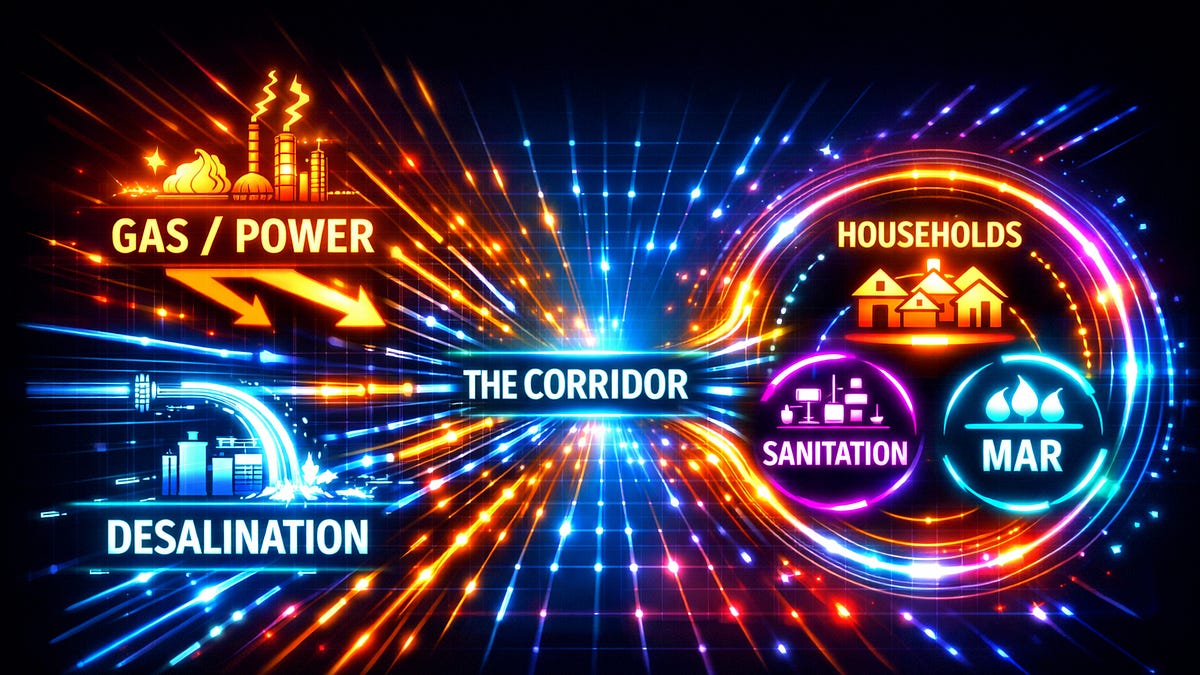
Part VII – Integrated Infrastructure Surge for Middle East Water Resilience
Subtitle: A rapid, integrated infrastructure surge to deliver more water across the Middle East’s most stressed watersheds.
Executive Summary
Water scarcity in the Middle East is not a future risk. It is an operating condition.
In Part VI, we showed that delay compounds harm and turns solvable water shortages into permanent failures; Part VII responds by treating speed, deployability, and survivability as first-order engineering requirements.
Part VII focuses on the infrastructure surge itself: how to move quickly, at scale, across the Jordan, Euphrates–Tigris, and Nile watersheds to deliver measurable water outcomes. The surge prioritizes systems that can be deployed immediately—household plumbing, sanitation, corridors, and new supply—while remaining compatible with long-term institutional control.
The sequencing is deliberate:
- Fix last-mile losses first
- Add new water supply in parallel
- Tie assets together so they are visible, shared, and defensible
- The surge is not simultaneous; it is fast, conditional, and uneven by design.
Financing is treated as a constraint, not the subject. Systems are designed to operate without permanent charity or indefinite subsidy, but funding mechanisms are discussed only where relevant to execution.
The intent is practical: deliver more water, faster, using infrastructure that survives politics, conflict, and time.
What This Is
This is not a vision piece. It is an execution plan.
Part VII describes a fast, integrated infrastructure surge across the Jordan, Euphrates–Tigris, and Nile watersheds. The objective is simple:
Deliver more water, faster, using systems designed to pay for themselves once deployed.
No solar dependency. No open-ended aid. No theory without pipes.
Governing Constraint (Design, Not Advocacy)
This surge is engineered under real-world constraints.
Infrastructure must:
- Operate continuously
- Be repairable locally
- Scale without depending on permanent aid
Design choices favor systems that can transition to self-supporting operation once deployed. Financing mechanisms exist to enable execution, but they do not define the architecture.
Designs that cannot be deployed quickly, repaired under stress, or expanded without delay are treated as failures, regardless of theoretical efficiency.
Strategic Objectives (2026–2035)
- Immediate access: 10,000+ household plumbing kits by 2028
- New supply: Large-scale desalination added in parallel
- Loss reduction: Cut 30–60% distribution losses
- Stability: Build infrastructure factions are incentivized to protect
- Durability: No system dependent on permanent subsidies
1. Plumbing First: Fast, Local, Revenue-Coupled
Why Start Here
- Most water loss happens after treatment
- Household plumbing is the fastest way to turn water into outcomes
- Reliability at the tap builds trust faster than megaprojects
What Gets Deployed
- Modular plumbing kits (1 household each)
- Toilets, taps, greywater separation
- Compact septic or biodigester units
How It Pays: Displacing the "Tanker Mafia"
- Monthly service fees
- Set below tanker and bottled-water costs to incentivize adoption and drain revenue from unofficial "water lords"
- Fees fund maintenance, replacements, and expansion
Plumbing kits are self-liquidating assets, not aid.
2. Transitional Sanitation and Recharge
Why Septic (for Now)
- Centralized wastewater takes years
- Conflict zones need deployable sanitation
System Design
- Small precast tanks with biological treatment
- Greywater routed to:
- Infiltration galleries
- Managed aquifer recharge (MAR)
Engineering Benefit
- Cuts evaporation losses
- Restores aquifers locally
- Reduces disease without waiting for full networks
3. New Water Supply: Desalination
What Powers It
- Nuclear for baseload desalination
- Natural gas for:
- Startup
- Maintenance downtime
- Phased commissioning
No solar dependency. No storage fragility.
Scale
- 3 major plants (one per watershed)
- Built incrementally
- Capacity added only when downstream demand is paid for
4. Multi-Use Infrastructure Corridors
Why Corridors Matter
Pipes fail when they are isolated. Corridors make infrastructure:
- Visible and Defensible: Hardened, monitored rights-of-way.
- Economically useful beyond water: Bundling high-value services ensures local actors are incentivized to protect the line.
What Corridors Carry
- Water pipelines (sensor-equipped for immediate sabotage detection)
- Natural-gas-backed power
- Fiber for monitoring, surveillance, and access
- Lighting and maintenance access
- Rest stops for people and animals
Shared rights-of-way reduce cost and sabotage risk.
5. Power Strategy (Explicit)
All operational power is natural gas–based.
Reasons:
- Dispatchable
- Repairable locally
- Compatible with existing grids
- No battery logistics
NG is treated as infrastructure, not ideology.
6. Financing: How This Actually Gets Built
Instruments Used
- Blue bonds
- Performance-linked tranches
- User-fee–backed debt
Revenue Sources
- Household water service fees
- Municipal bulk water contracts
- Corridor service charges
What Is Not Assumed
- Permanent grants
- Endless philanthropy
- Donor-funded operations
Volunteers reduce cost. Revenue sustains systems.
7. Phasing Under Delay Constraints
Phase 1 (2026–2028)
- Plumbing kits + sanitation surge
- One desalination plant under construction
- Pilot corridors in all three watersheds
Phase 2 (2029–2032)
- Expand only where cash flow is positive
- Add desalination capacity
- Extend corridors
Phase 3 (2033–2035)
- Full handoff to local operators
- Bond retirement underway
- Systems fully institutionalized
8. Metrics That Matter
- % OPEX covered by user fees
- Water delivered per dollar invested
- Time to cash-flow positive
- Reduction in tanker water dependence
- System uptime during conflict
If a metric can’t be measured, it doesn’t drive decisions.
9. Why This Reduces Conflict
People protect what works.
Infrastructure that:
- Delivers daily value
- Is paid for locally
- Serves multiple groups
creates shared incentives for stability. Water stops being leverage and becomes background utility.
Transition to Part VIII: Scaling the Surge
The strategies outlined here for the Jordan, Euphrates–Tigris, and Nile watersheds are not isolated experiments. They are the field-testing grounds for a Global Water Engineering Surge (GWES).
By proving that infrastructure can be revenue-coupled, defensible, and self-liquidating in the world’s most complex watersheds, we lay the groundwork for a six-continent mobilization.
In Part VIII, we move beyond regional resilience to the Global Standardization Mandate:
- The SDU: Moving from bespoke desalination to mass-produced Standardized SMR-Desalination Units.
- The Civil Corps: Leveraging a global pool of civil engineering talent to secure permanent water adequacy within a rapid three-year window.
- The Commitment: Transforming water from a scarce resource into a permanent, government-backed public good that prevents approximately 400,000 annual child deaths.
Next Tuesday: Part VIII – The Global Water Engineering Surge: A Six-Continent Mobilization.
Closing
This surge is not charity.
It is applied engineering under real constraints:
- Political
- Financial
- Physical
If it works here, it works anywhere water scarcity is treated as a system problem — not a slogan.
Owen’s Applied Thinking Where reasoning meets the real world.