
The Difference Between a Genome and DNA

Exploring the hidden logic and overlooked systems of everyday life, from the perspective of an engineer.
It's not activism. It's not theory. It's engineering.
The same four letters.
I still can't pronounce the difference between a genome and DNA. Turns out there isn't one to pronounce.
DNA is the paper and ink. The genome is the entire book. Every cell in your body has the whole book — not a chapter, not the relevant parts, not a summary. The complete text. Whether the cell is in your liver or under your thumbnail, the library is identical. What differs is the librarian: which genes are switched on, which are silenced, which are never opened in that tissue.

This is not a metaphor. It is the mechanism.
Every living thing on Earth — bacterium, redwood, whale, you — runs on the same four letters: A, T, G, C. The same four bases, arranged in sequences three letters at a time, that form the codons a cell reads to build proteins. The codon that tells a bacterium to build glycine is the same codon that tells a human cell to build glycine.

This has been demonstrated in the most concrete way possible: since 1982, human insulin has been manufactured by bacteria reading human DNA. The organism doesn't know what it's making. It reads the sequence, follows the code, and produces the molecule. The genetic code is universal enough that it works across kingdoms of life without modification. Eli Lilly's Humulin was the first commercially produced recombinant protein. It is still produced this way.
One origin. One molecule. Four letters. Three and a half billion years of elaboration.
The one partial exception is viruses. Some — influenza, HIV, SARS-CoV-2 — carry RNA instead of DNA. Same logic, slightly different molecule. RNA is single-stranded, less stable, optimized for different roles. The translation machinery is the same. The storage medium differs.
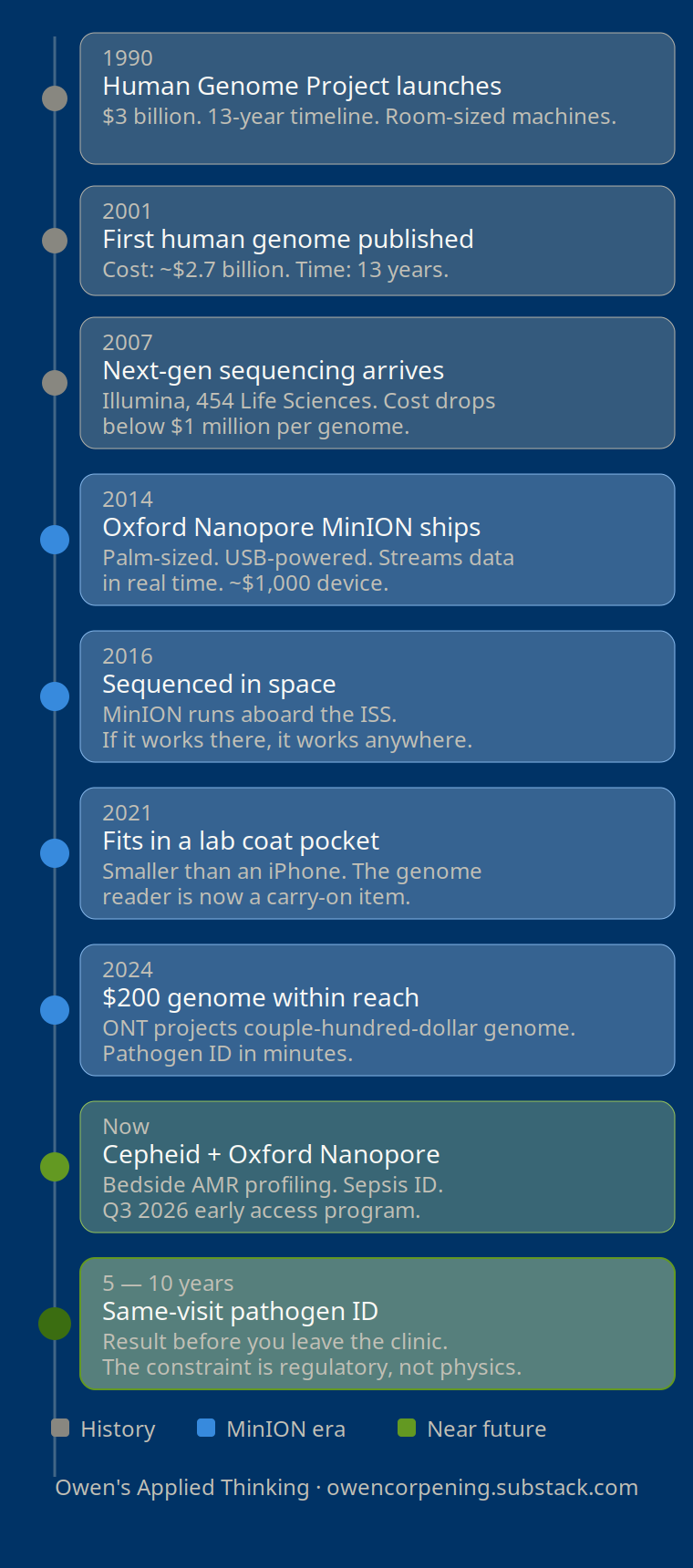
From $3 billion and a decade to a lab coat pocket. The constraint is no longer the physics.
My grandfather practiced medicine for decades. My father after him. Two generations of physicians spent careers working with patients whose every cell carried the complete instruction set for a human being — in every tissue they examined, every culture they ran, every diagnosis they made. The book was always there.
They knew it in principle. The structure of DNA was published the year before my grandfather finished medical school. By the time my father was in residency, the central dogma — DNA to RNA to protein — was textbook. They understood that the sequence existed.

Not at the bedside. Not in the time it takes to see a patient. Not at a cost that made the question worth asking in a clinical encounter.
That is what is new.
The genome was always present in every sample, every culture, every slide they ever examined. The ability to read it quickly, completely, at the point of care — that is an engineering development, not a biological one. The molecule did not change. The instrumentation did.
My grandfather knew what DNA was. He just didn't have a machine that could read it before the patient left the room.
That gap — between the information that was always in the sample and the ability to extract it in time to act — is the problem a new generation of instruments was built to close.
That is a longer story. It starts with the same four letters.
The longer story: The Sequencer in Your Doctor's Pocket (coming soon).
If you found this useful, subscribe to Owen's Applied Thinking — new pieces every Monday and Tuesday. No filler, no ideology. Just the hidden logic of systems.