
The Unintended Casualties of Clean Combustion
A footnote to "The Decade of Restoration"
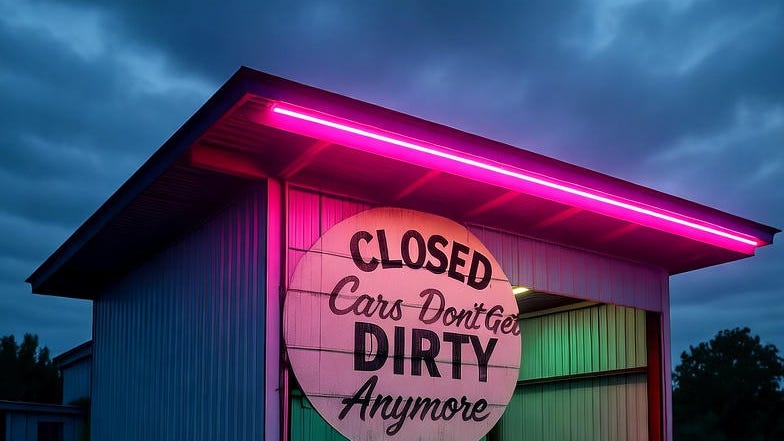
The Great Charity Car Wash Collapse of 2027
Nobody saw it coming.
By the third year of the CNG transition, high school booster clubs and church youth groups across America faced an existential crisis: cars weren't getting dirty anymore.
The Economics of Grime
The traditional charity car wash had always relied on a simple equation:
- Urban air deposits oily particulate film on vehicles
- Highway driving adds bugs, road spray, and exhaust residue
- Cars become visibly grimy within 2–3 weeks
- Guilt-free $10 donation = sparkly car + good cause
But CNG combustion changed the chemistry.
No particulate emissions = no black film coating. The greasy residue that accumulated on hoods, windshields, and side mirrors—the stuff that made cars look neglected even when they weren't—simply stopped appearing.
Rain became sufficient maintenance. A garden hose every few weeks handled the rest. Cars stayed cleaner, longer, with almost no effort.
The Pivot
By 2028, savvy organizations had adapted:
"We'll Vacuum Your Interior Instead"
The charity detailing operation was born. Because while exteriors stayed clean, interiors remained disaster zones of French fries, dog hair, and mysterious sticky spots. Fifteen-minute interior cleanouts at $20 per car became the new model.
"CNG Compressor Fundraiser"
Some communities pooled charity car wash proceeds to install shared neighborhood CNG compressors—essentially turning the fundraiser into infrastructure investment. "Your $20 helps 10 families refuel at home" proved surprisingly compelling.
"The Nostalgic Experience"
A few holdouts kept the traditional model alive purely as theater—soap suds, sponges, teenagers getting soaked. Not because cars needed it, but because people missed the ritual. The car wash became performance art.
Other Strange Casualties
The Quick-Lube Industry
Jiffy Lube and Valvoline franchises hemorrhaged revenue as oil change intervals went from 3,000 miles to 20,000+ miles. Many converted to CNG system maintenance shops. Others simply closed.
Car Wash Chains
The automated tunnel washes survived—barely—by pivoting to "premium detailing" and interior services. But the weekly wash subscription model collapsed. Memberships that once cycled weekly became monthly... then quarterly.
Detailing Supply Companies
Manufacturers of bug-and-tar remover, wheel cleaners, and degreasing compounds watched sales plummet. The chemicals designed to cut through petroleum-based road grime had no market anymore.
Gas Station Squeegees
The iconic squeegee bucket—that murky water with the battered scrubber—became obsolete. Windshields stayed clear. The entire ritual of "squeegee while pumping" disappeared when home refueling eliminated the pump entirely.
The Unexpected Winners
Mobile Detailing Services
Premium services focusing on interiors—deep cleaning, odor removal, upholstery treatment—exploded. If the outside stayed clean for free, people invested in the inside.
Ceramic Coating Installers
With exteriors naturally cleaner and less corroded, protective coatings became lifetime investments rather than temporary measures. A $1,200 ceramic coating that lasts 10+ years instead of 3–5 years became economically rational.
"Old School" Hand Car Wash Shops
The immigrant-run hand-wash operations that emphasized meticulous care and personal service found a niche: affluent customers who wanted the experience of a hand wash, even if unnecessary. It became a luxury, not a necessity.
The Cultural Shift
By 2030, the idea of a "dirty car" had been redefined.
Old definition: Grimy, film-covered exterior requiring weekly attention
New definition: Dusty from a camping trip, muddy from off-roading, or bird droppings
The ambient griminess—the slow, inevitable coating of petroleum-derived soot that made every parked car look neglected—was gone.
Charity car washes became charity detailings. The squeegee bucket became a museum piece. And America discovered that when you stop burning oil in millions of engines, you stop needing to constantly scrub its residue off everything.
The Broader Lesson
The CNG transition didn't just change energy or emissions—it eliminated entire categories of maintenance that had seemed eternal.
Oil changes became rare. Fuel injector cleaning vanished. Spark plugs lasted indefinitely. Engine rebuilds replaced new car purchases. And yes, charity car washes had to reinvent themselves.
Each small change cascaded. Each eliminated task freed time, money, and labor for something else.
That's what solving problems you control looks like: not just fixing the big issue, but discovering dozens of smaller benefits you never predicted.
Even if it meant high school football teams had to get creative about fundraising.
"We didn't set out to kill the charity car wash. We just stopped making cars that needed washing."
— Anonymous CNG conversion mechanic, 2029